
The joint statement issued after Prime Minister Narendra Modi and President Barack Obama's first-ever summit is high on intent and ambition. Notably missing from the statement is India's refusal to be America's partner in its war against ISIS.

'There are reports of political dissent mounting on Xi Jinping's handling of the Wuhan fallout.'

Tata-SIA will kick off with full-service domestic operations.

Despite the slowdown, property investments can give them good returns over the long term

Indians at large harbour a notion that their country is cherrypicking out of the American basket of goodies, but the policymakers in Delhi and the political leadership are well aware that it can only be a pipe dream since a military alliance with a superpower is a profound irrevocable commitment, observes Ambassador M K Bhadrakumar.
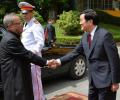
India and Vietnam on Monday inked seven pacts, including one to enhance cooperation in the strategic oil sector, as they called for "freedom" of navigation in the South China Sea, a remark which could irk China, which has been claiming territorial sovereignty over the high seas.

Rijiju said the central government will rehabilitate all Indian citizens in the Naga group if they abjure violence.

The India government needs to work on policies that can enhance global trade.
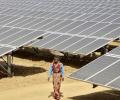
A billion dollars in renewable energy is huge.

'There are major implications for India. Though there was a transparently thin attempt to project the troop reduction as intended to promote peace, the downsizing is actually part of plans to streamline and strengthen the PLA, capable of defending China's national interests at home and abroad,' says Jayadev Ranade.

Moving ahead with their new mantra -- Chalein Saath Saath: Forward Together We Go -- Prime Minister Narendra Modi and United States President Barack Obama on Tuesday vowed to deepen cooperation in every sector for the benefit of global stability and people's livelihoods over the next ten years.

This is the joint statement issued by the ministry of external affairs on the visit of US President Barack Obama to India.
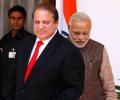
The government has returned to talks with Pakistan, but can it withstand pressure from a jingoistic press and a rabidly nationalistic social media.
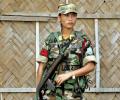
Naga rebel groups remain divided over the pact. Moreover, secrecy on accord creates apprehension in the society. K Anurag reports
.jpg)
Because of corrections in property prices and oversupply in the office segment, the rich are investing in hospitals, warehouses, ATMs and other alternatives to traditional investment options.

India has sought access to Lashkar-e-Tayiba operative David Headley, the Mumbai terror attack convict now lodged in a US prison, as it insisted on bringing to justice the perpetrators of the 26/11 assault.

'India should think big: About how in a multi-polar world, India can indeed be one of the poles, rather than being a secondary power that has to worry about 'alignment' with one of the poles. A G3 in other words, India should look to getting others to align with itself rather than the US or China,' says Rajeev Srinivasan.

'Let me talk about young Indian startups with their hearts in the right place and how they are proving that innovations that represent 'affordable excellence' -- breaking the myth that 'affordability' and 'excellence' cannot go together -- is indeed possible!' says Dr R A Mashelkar, the eminent scientist, in this fascinating feature.

The decision to not attend the forum attended by 28 heads of state and 130 national delegations is a clear break from its usual policy of going along with the crowd.

'He still has to deal with party norms and traditions and has been careful to follow the order of seniority,' points out Claude Arpi.

Are you staring at a mid-career crisis? Here's help!
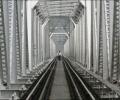
India has planned 14 strategic railway lines in areas bordering China, Pakistan and Nepal, but most of these projects are stuck for want of funds. Anusha Soni reports

'India's military posture has become significantly stronger than China's on the 3,500-kilometre Line of Actual Control.' 'This is enhancing confrontation between the two sides,' points out Ajai Shukla.

'It is in the interest of both sides that the visit of the US President is seen as being successful. Both sides have invested considerable political capital in it. This rapid exchange of visits and the decisions taken have to be justified, beyond the symbolism, which is no doubt important in itself. This opportunity to impart a fresh momentum to ties should not be missed,' says former foreign secretary Kanwal Sibal.

With EU, it is part of the FTA that we will need to negotiate.

'The real test will be in defence-related deals, for instance the Javelin anti-tank missile: Is the US willing to co-develop something with India, on terms that will support the 'Make in India' initiative? Is there defence technology transfer? Or will it dump old junk on India?' asks Rajeev Srinivasan.

The Indian Spring represented by Anna Hazare's anti-corruption campaign, which has culminated in the Aam Aadmi Party's impressive electoral debut in New Delhi, began around the same time as the Arab Spring in 2011 but they led to different outcomes in India and the Arab world, says Ramesh Ramachandran.

'Modi wants to be pragmatic -- acknowledge the problem of Pakistan and that full reconciliation is essentially a non-starter, but at the same time grab the low-hanging fruits (such as trade) to put things on a more even keel, to engender enough stability in the relationship to allow him to focus on other priorities.'

While chips have become ubiquitous, Moore's Law has remained a self-fulfilling prophecy even half a century later. Not bad for an industry where the time scale is not measured in decades and centuries, but in annual quarters, says Shivanand Kanavi.

India'sstartups have a good beginning but will they survive competition is a big questions which needs immediate attention.

Cashi Crisis: Day 9: Aaj ki Taaza Khabar!
 © 2026 Rediff.com - Advertise with us - Disclaimer - Privacy Policy - Sitemap - Feedback - About us - Terms of use - Grievances